MOOA Mattress — Certified, Cooling, Fiberglass-Free

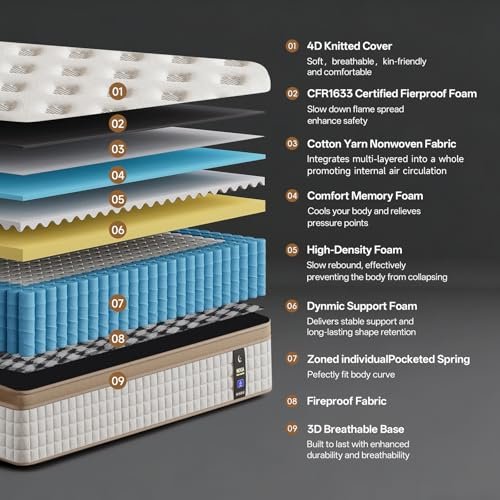
MOOA builds one mattress: a 12-inch medium-firm hybrid with independently wrapped pocket coils, copper-infused open-cell foam, and a dual CertiPUR-US and OEKO-TEX certified material stack across every layer — not just the comfort surface. The flame-retardant barrier meets CFR 1633 U.S. safety standards using a cotton fire layer instead of fiberglass. Factory-direct to Amazon in four sizes, Full through King, with no showroom markup and no guesswork on what's actually inside.
✓ CertiPUR-US + OEKO-TEX Certified✓ 100% Fiberglass-Free✓ 680-Lb Structural Rating
Shop MOOA on Amazon →
MOOA King Mattress in a Box
Dual-Certified Materials Across Every Layer Dual-Certified Materials Across Every Layer

Every foam layer carries both CertiPUR-US and OEKO-TEX Standard 100 certification — the cotton CFR 1633 fire barrier replaces the fiberglass inner sock that's contaminated countless other brands.

Three Mechanisms, One Cooling System Three Mechanisms, One Cooling System

A 4D knitted cover, open-cell copper-infused memory foam, and separated pocket coil air channels work together — tested at up to 4°F cooler than traditional hybrids, with 83% moisture-wicking performance.

9 Zones That Respond Independently 9 Zones That Respond Independently

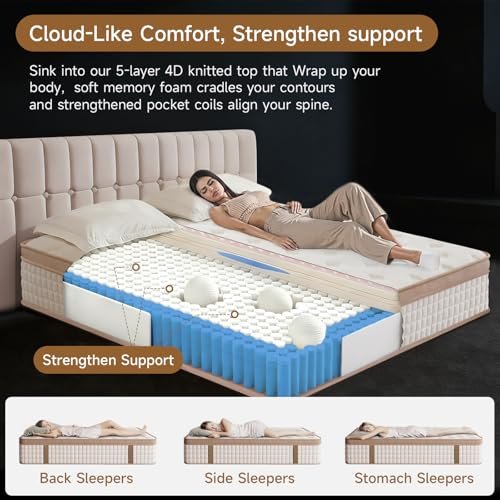
Individually wrapped pocket coils compress by pressure zone, not as a single surface — the coil under your shoulder and the coil under your lumbar are doing different jobs by design.

680-Lb Rating, Reinforced to the Edge 680-Lb Rating, Reinforced to the Edge

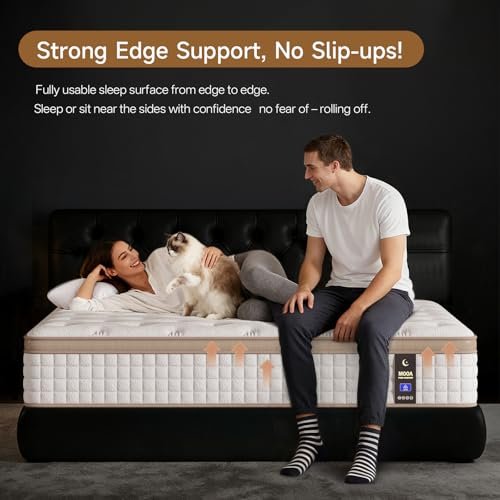
High-tensile steel pocket coils support up to 680 lbs total, and perimeter edge coils are reinforced separately so the full sleep surface stays usable — not just the center.

MOOA Mattress Sizes — One Build, Four Options

Every MOOA mattress shares the same 12-inch medium-firm hybrid construction — 9 layers, pocketed coils, certified foam, cotton fire barrier. The choice between Full, Queen, and King comes down to who's sleeping on it and how much surface they need.

MOOA Mattress Full Size

Full Hybrid 12 Inch

At 39 lbs, the Full is the lightest mattress in the MOOA lineup and the only size with a pure cotton cover listed in the specs. It ships in the most compact form factor — 144.78 × 25.4 × 25.4 cm — and carries the same 680-lb weight capacity as the King.

The right call for single sleepers, first apartments, and teen rooms who want full hybrid construction and dual certification without paying for a surface they don't need.

See on Amazon
MOOA 12 Inch Queen Mattress - Mattress Hybrid Cooling Gel Memory Foam & Pocket Coils

Queen Hybrid Medium Firm

The highest-rated model in the lineup at 4.4 stars, and the only size with explicitly quantified cooling data in the listing: up to 4°F cooler than traditional hybrids, 83% moisture-wicking performance. Reinforced edge springs are called out as a standout feature, and the CFR 1633 cotton fire barrier language is the most detailed of any size.

Best for couples and hot sleepers who want verified cooling numbers and the most fully documented safety certifications in the lineup.

See on Amazon
MOOA King Size Mattress

King Hybrid Standard

A straightforward king hybrid with 1,000 pocketed coils, 680-lb weight capacity, and confirmed compatibility with both box spring and platform bed frames. No copper-cooling premium language — this is the no-frills king option for buyers who want the structural specs without the added marketing layer.

Solid choice for buyers who need a king hybrid and want box spring compatibility confirmed before purchasing.

See on Amazon
MOOA King Mattress in a Box

King Hybrid Copper Cooling

The highest review count in the lineup at 175 reviews and 4.3 stars. Copper-infused gel memory foam is the headline feature — it's the only size to lead with it in the product title. The 7-zone support system names all seven body regions explicitly: head, shoulders, back, waist, hips, legs, and ankles. At 95 lbs, the shipping weight confirms the structural build you'd expect from a king.

The most documented product in the lineup — best for couples in master bedrooms who want the most complete zone-support spec and the copper-infused cooling stack working at full king scale.

See on Amazon

Which MOOA Size Fits Your Situation

The short answer: MOOA makes one mattress in four sizes, so the construction, firmness, and certifications are identical across the lineup. The decision comes down to who's sleeping on it, how much space they have, and whether they're sharing. Here's how to match your situation to the right size without overthinking it.

MOOA King Mattress in a Box

First Apartment or Solo Sleeper

The Full Hybrid is the right call. At 39 lbs, it's the only size in the lineup that one person can reasonably maneuver solo — up a staircase, through a narrow hallway, into an elevator. The 75" × 54" sleep surface covers a standard full frame exactly, and the compressed shipping dimensions (roughly 57" × 10" × 10") clear most building doorways without gymnastics. You get the same 680-lb structural rating and dual CertiPUR-US and OEKO-TEX certification as the king. Nothing is stripped out to hit a smaller size.

Guest rooms and teen bedrooms land here too. A 12-inch medium-firm hybrid in a full is a meaningful upgrade from a budget innerspring that most guest room mattresses still are — and the same certifications matter when the person sleeping on it isn't you.

Couples or Anyone Who Shares a Bed

The Queen Hybrid is where most couples should start. At 60 inches wide, a queen gives two people enough space to sleep without occupying the other's territory — which is more important than it sounds when one of you runs hot and the other is a light sleeper. The queen is also the only size with explicitly quantified cooling data in the product specs: tested to sleep up to 4°F cooler than traditional hybrids, with 83% moisture-wicking performance. That's not a claim MOOA makes for all sizes — it's documented specifically for the queen.

The reinforced edge springs are also called out as a standout feature on the queen specifically, which matters for couples who want to use the full 60 inches of surface rather than unconsciously migrating toward the center to avoid edge softness.

Master Bedroom or Larger Frame

If you're buying for a master bedroom with a standard king frame, you have two options. The King Hybrid Copper Cooling leads with copper-infused gel memory foam in the title, names all seven support zones explicitly (head, shoulders, back, waist, hips, legs, ankles), and carries 175 reviews at 4.3 stars — the highest review count in the lineup. It weighs 95 lbs, which is exactly what you'd expect from a fully built-out king hybrid and confirms the structural spec isn't a rounding approximation.

The King Hybrid Standard is a cleaner option if you're not specifically shopping for the copper-cooling feature. It carries 1,000 pocket coils and the same 680-lb weight capacity, and it's explicitly confirmed compatible with both box spring and platform bed frames — useful if you have an older box spring setup and want to confirm fit before ordering.

Hot Sleepers Regardless of Size

Any size in the lineup runs the same three-layer cooling system: the 4D knitted cover, open-cell copper-infused memory foam, and individually wrapped pocket coils that create open air channels through the body of the mattress. The queen has the tested numbers to back it up. If temperature regulation is the primary concern driving your purchase, the queen is the one to look at first — but the mechanism is present in every size.

Back Pain Is the Main Reason You're Looking

The 9-layer ergonomic construction addresses lumbar and shoulder zones independently, which is what most back-pain shoppers are actually asking for when they say they want "support." Independently wrapped coils respond to the pressure zone under them rather than deflecting as a unified surface — so the coil under your lumbar isn't doing the same thing as the coil under your shoulder. That distinction matters for back pain. The size you pick doesn't change this; every MOOA mattress is built on the same zoned coil system.

One honest qualifier: if your back pain is severe or related to a diagnosed condition, your physical therapist or doctor is a better guide than any product page. Mattress firmness can help. It can't substitute for medical advice.

What to Expect the First Few Weeks

Most mattress-in-a-box purchases go smoothly. But the ones that don't usually fail in predictable ways — and almost all of them come down to mismatched expectations in the first 48 hours or the first two weeks. Here's what's actually going to happen after the box arrives, and what it means.

Off-Gassing Is Normal and Temporary

New foam has a smell. That's the VOC off-gassing that CertiPUR-US testing is designed to limit — and it does: every MOOA foam layer is tested to confirm VOC emissions fall below the program's threshold. But "below the safety threshold" doesn't mean "no smell at all." You will probably notice it when you first unbox, particularly in the first 24 hours.

MOOA King Mattress in a Box

The fix is simple: unbox in the room where the mattress will live, open a window, and give it 24 to 48 hours before sleeping on it. The smell dissipates on its own. Running a ceiling fan or box fan across the surface speeds it up. Don't seal the mattress in a room with no airflow and wonder why it still smells on day three.

If the smell persists beyond 72 hours with ventilation, that's worth noting in a review — but it's not typical, and it's not a safety issue at certified VOC levels.

The 48-to-72-Hour Expansion Window

Compressed roll-packing works by compressing the foam and coil stack under significant pressure, then sealing it. When you cut the packaging, the mattress begins expanding immediately — but full expansion to 12 inches takes 48 to 72 hours at room temperature. Don't sleep on it for the first night if you can avoid it. The support zones won't be performing correctly until the foam and coils have fully decompressed.

If you're setting up on a tight schedule and have to sleep on it before 48 hours, you can — it won't damage anything. Just know that what you feel on night one isn't necessarily what you'll feel on night five.

The Two-Week Break-In Period

Here's the thing most mattress marketing glosses over: a new hybrid mattress doesn't feel the same on day one as it does on day 14. The foam needs time to respond to your body weight and sleep positions. The coils need to calibrate to the pressure zones you actually create. Medium-firm hybrids in particular often feel slightly firmer in the first week than they do after the break-in period, because the open-cell foam hasn't yet fully adapted to your body's specific contact points.

If you try the mattress for three nights and think it's too firm, give it the full two weeks before drawing a conclusion. This isn't a product-specific quirk — it's how hybrid foam and coil systems work mechanically. The r/Mattress community documents this consistently, and it's one of the most common sources of premature returns in the mattress-in-a-box category.

Honest Medium-Firm Reality by Body Weight

MOOA's medium-firm sits at roughly 6 out of 10 on the firmness scale — firm enough to keep most back sleepers' spines in neutral alignment, with enough surface give to accommodate a side sleeper's shoulder and hip. But that 6-out-of-10 feels different depending on how much you weigh.

Heavier sleepers (above 200 lbs) will find the medium-firm feel well-matched — the coils engage more responsively under greater load, and the high-density base foam provides the structural resistance that prevents the "bottoming out" sensation. Lighter sleepers (under 130 lbs) may experience the surface as slightly firmer than expected, because less body weight means less coil deflection, which means less of the plush comfort layer is being compressed into the body. If you're under 130 lbs and prefer a genuinely soft surface, be honest with yourself about whether medium-firm will satisfy you before ordering.

Who Should Not Buy MOOA

Every mattress fits some people well and some people not at all. MOOA's medium-firm hybrid is not the right choice if:

  • You strongly prefer a plush or soft surface — below a 4 out of 10 on firmness. The 9-layer construction isn't built for that feel, and no amount of break-in time will get you there.
  • You're a strict stomach sleeper who wants minimal surface depth. The foam comfort layers create some front-body contouring that some stomach sleepers find uncomfortable.
  • You need white-glove in-room delivery and mattress removal. MOOA ships as a box to your door. You'll need two people to move the queen (69 lbs) or king (95 lbs) from where it lands to where you want it.
  • You want to test it in a showroom first. There is no brick-and-mortar MOOA retail presence. The entire purchase happens online, and the first time you lie on it is after the box arrives.

None of these are flaws — they're just honest descriptions of what this product is and isn't. Knowing them before you order is more useful than finding out after.

What MOOA's Certifications Actually Cover

MOOA carries three material certifications: CertiPUR-US, OEKO-TEX Standard 100, and CFR 1633 compliance. These are real, verifiable, third-party standards — not marketing claims the brand invented. Here's what each one actually tests, why it matters, and why the combination is meaningful at MOOA's price point.

CertiPUR-US — What's Not in the Foam

CertiPUR-US is a testing and certification program administered by an independent organization that verifies polyurethane foam meets specific chemical safety thresholds. A mattress carrying this certification has been tested to confirm its foam is made without ozone depleters, heavy metals (mercury, lead, and others), formaldehyde, PBDE flame retardants, and certain phthalates. VOC emissions are also tested and capped — the smell of a new foam mattress comes from VOC off-gassing, and CertiPUR-US sets the limit on how much is acceptable.

The meaningful detail for MOOA: all foam layers carry this certification — not just the top comfort layer. Some brands certify only the visible or outermost foam layer and leave the base foam and transition layers uncertified. The certification covers the full material stack.

MOOA King Mattress in a Box

CertiPUR-US testing is conducted by accredited independent labs. The certification isn't self-reported by the manufacturer. You can verify a brand's certification status directly at certipurus.com.

OEKO-TEX Standard 100 — What's Not in the Fabric

OEKO-TEX Standard 100 covers the textile and fabric components of the mattress — the cover material, any batting or transition layers made from fabric, and the fire barrier textile. It tests for over 100 harmful substances including pesticide residues, heavy metals, allergenic dyes, and pH values outside the skin-safe range. The standard applies particularly to materials that contact skin directly, which makes cover fabric certification more relevant than most buyers realize.

Together, CertiPUR-US and OEKO-TEX cover different material categories — one addresses the foam chemistry, the other addresses the textile safety. Having both means the entire mattress material stack has been independently tested, not just the component that happens to be facing up.

CFR 1633 — The Fire Safety Standard and the Fiberglass Question

CFR 1633 is the U.S. Consumer Product Safety Commission's open-flame test standard for mattresses. Every mattress sold in the United States is required to meet it. The standard itself doesn't specify how a brand achieves compliance — it only requires that the mattress pass the open-flame test. This is where the fiberglass issue enters.

Fiberglass is one way to meet CFR 1633. It's cheap, effective as a fire barrier, and widely used in budget mattresses. The problem is that fiberglass is typically used as an inner sock around the foam layers — and when a cover is removed, washed, or the mattress is cut open, microscopic glass fibers can contaminate the surrounding area. The r/Mattress community on Reddit has documented this extensively. Search "mattress fiberglass contamination" and you'll find detailed threads describing cleanup scenarios that involve discarding furniture and deep-cleaning entire rooms.

MOOA meets CFR 1633 using a cotton fire barrier instead. The cotton layer achieves the same fire-resistance standard without the contamination risk. This is also why MOOA's product listings state "100% fiberglass-free" — it's not a marketing differentiator invented to sound reassuring; it's the direct answer to a documented concern that safety-conscious buyers are researching before they buy.

How to Check Any Mattress Before You Buy

You don't need to take any brand's word for it. Here's a practical checklist for evaluating any mattress's safety claims:

  • Search the brand name at certipurus.com to verify active CertiPUR-US certification — the database is public and updated regularly
  • Ask whether certification applies to all foam layers or only the comfort layer — the answer matters
  • Look for explicit "fiberglass-free" language and ask what the brand uses as a CFR 1633-compliant fire barrier instead
  • OEKO-TEX certification numbers can be verified at oeko-tex.com/en/our-standards/oeko-tex-standard-100
  • If a listing doesn't mention how it achieves CFR 1633 compliance, that's worth asking about directly via Amazon seller messaging before purchase

The brands to be cautious about are the ones that describe their materials in vague positive terms ("eco-friendly," "safe for the whole family") without citing any third-party certification program by name. Marketing language is not a substitute for a verifiable certification number.

What Certifications Don't Cover

Being honest here: CertiPUR-US and OEKO-TEX certify what's in the materials, not how the mattress performs over time. They don't guarantee a specific lifespan, sag resistance, or that medium-firm will feel the same in year three as it does in year one. Certifications are a floor on material safety — they're the beginning of what to check, not the end of it. Structural durability comes down to coil gauge, base foam density, and build quality, which certifications don't address.

Medium-Firm Works for Side Sleepers — Here's Why

Side sleepers are the most likely buyers to dismiss medium-firm before reading further. The assumption makes sense: side sleeping creates concentrated pressure at the hip and shoulder, and the instinct is to go softer to let those pressure points sink in. But the assumption misses what actually causes morning soreness in side sleepers — and why zoned coil design changes the equation.

The Real Source of Side Sleeper Back Pain

Most side sleeper back pain isn't caused by a mattress being too firm. It's caused by the spine being pulled out of neutral alignment when the hip sinks deeper than the shoulder, or when the lumbar region gets inadequate support and hangs unsupported between two contact points. A plush all-foam mattress can actually make this worse: the whole surface deflects together, hips sink, shoulders follow, and the lumbar gap widens. The sleeper feels comfortable at first — the surface is soft — but wakes up with lumbar soreness that compounds over time.

The fix isn't necessarily a softer mattress. It's a mattress where different zones respond differently to different amounts of pressure.

What Independently Wrapped Coils Actually Do

MOOA's pocket coil system wraps each spring in its own fabric pocket. This sounds like a construction detail that only matters to engineers, but the practical outcome is real: each coil compresses independently rather than as part of a connected grid. A traditional innerspring mattress — even a good one — deflects across a wide area when you apply pressure to any point. Push down in one spot and the surrounding coils pull down too. That's the "ripple effect" that causes both motion transfer and uneven pressure distribution.

Individually wrapped coils don't do that. The coil under your hip compresses to the degree your hip weight requires. The coil under your shoulder compresses to the degree your shoulder weight requires. They aren't mechanically connected, so they respond independently to what's above them.

Zones That Actually Map to a Side Sleeper's Body

MOOA's 9-layer ergonomic design includes targeted lumbar and shoulder zones — the two regions where side sleepers most commonly experience pain. The king's 7-zone support system names all seven regions explicitly: head, shoulders, back, waist, hips, legs, and ankles. Each zone is engineered to deliver a different response level. The shoulder zone has more give. The lumbar zone provides more resistance. That zoning is the structural answer to the question "how can medium-firm work for side sleepers?" — because "medium-firm" describes the overall feel of the surface, not the behavior of every individual zone.

A side sleeper lying on the MOOA hybrid isn't lying on a uniformly medium-firm surface. They're lying on a surface where the shoulder zone yields more readily than the lumbar zone does. That's what keeps the spine horizontal and the pressure points distributed rather than concentrated.

Body Weight Still Matters

Zoned support doesn't override physics entirely. The degree to which the shoulder zone yields depends partly on how much force is applied to it — which depends on body weight. Heavier side sleepers (above 180 lbs) will find the shoulder and hip zones responsive and accommodating. Mid-range sleepers (130 to 180 lbs) are squarely in the target zone for this construction. Lighter side sleepers — particularly those under 120 lbs — may find that even the more compliant shoulder zone doesn't deflect enough to feel genuinely accommodating, because there simply isn't enough force to engage the coils fully.

This isn't a flaw in the design. It's an honest description of how medium-firm pocket coil hybrids behave under different loads. If you're a lighter sleeper and every mattress you've tried in the medium-firm range has felt too structured at the shoulder, that pattern is likely to continue with MOOA. The zone design helps — but it doesn't fully compensate for very low body weight on a medium-firm surface.

The Side Sleeper with Lumbar Pain Specifically

This is the buyer profile where MOOA's construction makes the strongest case. A side sleeper with existing lumbar sensitivity needs two things simultaneously: enough shoulder give to keep the spine level, and enough lumbar support to prevent the lower back from sagging unsupported. A soft mattress delivers the first and fails at the second. A firm mattress delivers the second and fails at the first. A zoned hybrid — with differential coil response by body region — can deliver both.

That's the mechanical argument. The honest qualifier, per the brand's own approach: if lumbar pain is severe, clinically diagnosed, or getting worse, a mattress change is one piece of the puzzle, not the whole answer. A physical therapist's assessment of your specific alignment needs should inform the decision alongside any product research you do here.

Setting Up Your MOOA Mattress the Right Way

Getting a 95-lb box through your front door and onto a bed frame is the part no mattress review covers. Here's the practical sequence — from delivery day through the first real night of sleep — so nothing goes wrong at any stage.

Before It Arrives

Measure the doorways, hallways, and stairwells between your front door and the room where the mattress will live. The compressed shipping box is roughly 57 inches long for a queen (about 160 cm) and longer for a king — long enough that a tight 90-degree turn in a narrow hallway becomes a real problem. If your building has an elevator, confirm the interior dimensions before delivery day. Most residential elevators handle a queen box; king boxes are borderline on some older buildings.

Have two people available. A queen MOOA mattress weighs 69 lbs in the box; the copper-infused king weighs 95 lbs. These are manageable weights for two people carrying in a straight line. They're not manageable solo up a staircase, particularly when the load is awkward and long. Don't order a king if you're setting it up alone — you need help.

Clear the room before the box arrives. Moving furniture around a 95-lb compressed mattress is more difficult than doing it beforehand. Have the bed frame assembled and in final position. The mattress won't need to be moved again once it expands.

Unboxing

Get the box into the room where the mattress lives before cutting anything. The mattress will expand the moment you cut the outer packaging — you don't want to start expansion in a hallway or living room and then try to maneuver it through a doorway.

Use scissors or a box cutter to open the outer cardboard. The mattress inside is wrapped in a second layer of plastic, often sealed around a roll of compressed foam. Score the plastic carefully along the top edge — you're cutting toward the plastic, not toward the mattress itself. A slip of the blade here can nick the cover, so take your time.

Once the outer plastic is cut, the mattress will begin to unroll and expand on its own. Get it onto the bed frame before it's fully expanded — it's much easier to position when it's still partially compressed. Place it centered on the frame with about equal overhang on each side, then let it expand into position rather than trying to shift it after it's full size.

The 48-to-72-Hour Expansion Window

Open a window in the room immediately after unboxing. Ventilation serves two purposes: it speeds the expansion of the foam and coil layers by allowing air to circulate freely into the structure, and it clears the initial off-gassing smell that's normal with any new foam product. A ceiling fan or portable fan pointed at the mattress surface works well. Don't close the room up.

Full expansion to 12 inches takes 48 to 72 hours at room temperature (68–72°F). A cooler room slows expansion slightly; a warmer room speeds it. If after 72 hours the mattress still looks visibly thinner than 12 inches in any section, confirm the room has been adequately ventilated and give it another 24 hours. Lying on a mattress before full expansion can slow the process — the body weight compresses the foam before it's fully opened up.

Frame Compatibility

MOOA fits 99% of bed frames, including slatted bases, platform beds, box springs, and adjustable foundations. For slatted frames, the gaps between slats should be no wider than about 3 inches (roughly 7.5 cm) — wider gaps can allow the base foam to deflect into the openings over time, which causes uneven support. If your slats are widely spaced, a thin bunkie board or plywood sheet between the slats and mattress solves the problem without requiring a new frame.

If you're using a box spring, confirm it's structurally sound before placing the new mattress on it. A sagging or broken box spring transfers that unevenness directly to the mattress surface above it. The MOOA King Hybrid Standard explicitly confirms compatibility with box springs — that applies to a functioning box spring, not a compromised one.

Adjustable base compatibility is listed for the lineup, but if you're planning to use an adjustable foundation at significant incline angles, check the specific base's weight rating against the mattress weight before ordering.

The First Night and Beyond

If you can, wait the full 48 to 72 hours before sleeping on the mattress. If you can't, you can sleep on it after 24 hours — but know that the support zones won't be performing at their designed level yet, and your first-night impression isn't the definitive one.

Plan for a two-week adjustment period. Most hybrid mattresses take 10 to 14 days before the foam fully conforms to your body's specific pressure zones and the coils have calibrated to your weight distribution. A mattress that feels slightly firm in week one often reaches its intended feel by week two. Don't initiate a return based on a first-week impression — give the break-in period its full run before drawing a conclusion.


See the Queen Mattress Up Close Before You Buy

We embedded this walkthrough because reading specs only gets you so far — sometimes you need to see how the mattress actually looks and moves out of the box. You'll get a real-world look at the queen size from someone who bought it on Amazon and put it through its paces. Watch it before you order, especially if you're trying to judge the medium-firm feel or the build quality from a distance.

Which MOOA Mattress Size Fits Your Situation

MOOA builds one hybrid construction across four sizes — same pocket coil system, same certification stack, same medium-firm feel. The differences that matter are surface area, weight, cover material, and a few spec details that shift across the lineup. Here's everything side by side.

Feature Full Hybrid 12 Inch Queen Hybrid Medium Firm King Hybrid Standard King Hybrid Copper Cooling
Dimensions 75" × 54" × 12" 80" × 60" × 12" 80" × 76" × 12" 80" × 76" × 12"
Weight 39 lbs 69 lbs Not confirmed 95 lbs
Number of Layers 9 9 9 9
Coil Count Not listed Not listed 1,000 1,000+
Weight Capacity 680 lbs Not listed 680 lbs 680 lbs
Cover Material Cotton Knitted fabric Cotton Cotton blend
Certifications CertiPUR-US, OEKO-TEX, CFR 1633 CertiPUR-US, OEKO-TEX, CFR 1633 CertiPUR-US CertiPUR-US, OEKO-TEX
Amazon Rating 4.3 stars (175 reviews) 4.4 stars (44 reviews) 4.4 stars (44 reviews) 4.3 stars (175 reviews)

For single sleepers or space-limited rooms, the Full Hybrid's 39-lb weight makes it the easiest to move and set up solo — and it carries the same 680-lb structural rating as the king. Couples choosing between the two queens and kings should know the Queen Hybrid Medium Firm has the most completely documented spec sheet in the lineup, including the verified 4°F cooling advantage and the explicitly named CFR 1633 cotton flame barrier. If you're deciding between the two king variants, the King Hybrid Copper Cooling's 95-lb confirmed weight and 175 verified reviews make it the better-documented option; the King Hybrid Standard is a straightforward alternative if the copper-cooling feature isn't a priority.

What MOOA Buyers Notice After the First Few Weeks

"I've had lower back issues for years and went through two cheap foam mattresses that both developed sags within 18 months. The MOOA queen has held its shape and — more importantly — I'm not waking up with that familiar stiffness in my lumbar anymore. It took about two weeks to fully break in, but after that the support felt genuinely different from anything I'd slept on before."
— Marcus T., Physical Therapist Assistant, 41
"My husband is a 5 a.m. riser and I'm a light sleeper. We've tried two other hybrid mattresses and both transferred too much movement. The MOOA king honestly surprised me — I can feel him getting up slightly, but it doesn't wake me up. The cooling is also real; I used to kick the sheets off every night and that's mostly stopped."
— Priya M., Healthcare Administrator, sharing a king with a partner on a different schedule
"First apartment, first real mattress purchase — I was nervous about buying something I couldn't test in person. The CertiPUR-US and OEKO-TEX certifications pushed me over the line. Setup took about 20 minutes with a roommate helping, and it was fully expanded by the next morning. Medium-firm is firmer than I expected at first, but after a week it felt right."
— Jordan C., Recent College Graduate, first apartment in Chicago
"Bought the full size for my teenage daughter's room after reading too many Reddit threads about fiberglass contamination from other brands. The cotton fire barrier and dual certification were the deciding factors. It arrived with a mild smell that cleared in about 36 hours with the window open — I wish I'd known to expect that, but it's a non-issue now and she sleeps well on it."
— Diane R., Parent buying for a teenager's bedroom
"The edge support on the queen is noticeably better than my old mattress. I sit on the edge every morning to put shoes on and there's no collapse. My previous bed had turned that corner into a slope after about a year. The cooling claims also hold up — I run warm and haven't had the overheating issue I expected from a foam-heavy hybrid."
— Kevin L., Remote Worker, back sleeper who also uses the mattress edge as a seating surface
"Decent mattress for the price point. The motion isolation works — I can confirm that. My one honest note is that if you're a side sleeper under 140 pounds, the medium-firm will feel firm rather than balanced at first. I'm 128 lbs and noticed some shoulder pressure in the first week. It did soften slightly with use, but worth knowing before you buy."
— Alicia W., Yoga Instructor, lightweight side sleeper

Common Questions About MOOA Mattresses

Are mattresses that come in a box actually good?

Yes — the compressed roll-packing format affects delivery, not construction. The foam layers and pocket coils inside a MOOA mattress are identical whether it arrives rolled or flat. CertiPUR-US and OEKO-TEX certification is tested on the finished foam, not the packaging method. MOOA's hybrid expands fully within 48–72 hours and fits 99% of standard bed frames.

What makes a king mattress in a box worth buying?

The specs that matter most in a king box mattress are coil count, weight capacity, edge reinforcement, and third-party certifications — not brand name recognition. The MOOA King Hybrid Copper Cooling uses 1,000+ individually wrapped pocket coils, supports up to 680 lbs, and carries both CertiPUR-US and OEKO-TEX certification. Those are verifiable numbers, not marketing language.

What are the real drawbacks of a mattress in a box?

Three honest ones: no try-before-you-buy, a 24–48 hour off-gassing period after unboxing (trace VOC smell that dissipates — CertiPUR-US certification limits emissions to a tested safe threshold, but the smell is still noticeable), and no white-glove in-room delivery. You'll need two people to move and position the box. These are format trade-offs, not material quality issues.

Is MOOA a good mattress for back pain?

MOOA's 9-layer ergonomic design targets lumbar and shoulder zones with independently wrapped pocket coils that respond to pressure by body region rather than deflecting as a single surface. Back sleepers and combination sleepers with lumbar sensitivity generally do well on the medium-firm feel, which sits around a 6 out of 10 on the firmness scale. For back pain specifically, a hybrid's zoned coil response is the relevant mechanism — not the foam layers alone.

What mattresses should you stay away from?

Watch for three red flags: a fiberglass inner sock used as a fire-retardant layer (contamination risk if the cover is removed or damaged), missing or unverified certifications on the foam, and no stated weight capacity. MOOA uses a CFR 1633-compliant cotton fire barrier instead of fiberglass, carries dual CertiPUR-US and OEKO-TEX certification across all foam layers, and rates structural capacity at 680 lbs across the lineup.

What's the best mattress for scoliosis?

Medium-firm hybrid mattresses are frequently recommended by physical therapists for scoliosis because they balance surface give with consistent lumbar support — preventing both hammocking (too soft) and pressure point buildup (too firm). MOOA's pocket coil system responds independently to different pressure zones, which helps maintain spinal position during position changes. That said, mattress selection for scoliosis should involve your medical provider, not just product research.

How do 5-star hotels keep their mattresses feeling so good?

Hotel mattresses typically use medium-firm hybrid constructions with reinforced edge support and high-density base foam that resists body impressions over thousands of sleep cycles. The consistent surface feel comes from pocket coils that respond to pressure without transmitting movement across the bed — the same mechanism MOOA uses. Hotels also replace mattresses on a fixed schedule; that maintenance discipline matters as much as the construction.

How long does a MOOA mattress take to fully expand?

MOOA's roll-packed mattresses expand to full height within 48–72 hours of unboxing. Most reach 95% of their final shape within the first few hours. It's worth waiting the full 48 hours before sleeping on the mattress, both to allow complete expansion and to let any trace off-gassing dissipate. Unbox in a ventilated room — open a window — for the best first-night result.

Does the MOOA mattress work on a box spring?

Yes. The MOOA King Hybrid Standard explicitly lists box spring compatibility in its specs, and the full lineup is designed to fit 99% of standard bed frames including slatted bases, box springs, platform beds, and adjustable foundations. No tools or special hardware required. Check that slat spacing doesn't exceed 3 inches for proper support across the mattress base.

What do MOOA mattress reviews say overall?

Across 219 Amazon reviews, the lineup averages 4.3–4.4 stars. The most consistently mentioned positives are cooling performance, motion isolation, and support balance — described in affiliate coverage as "consistent, well-balanced without feeling too soft or too firm." The honest caveat from lighter sleepers: medium-firm reads as genuinely firm below about 140 lbs, particularly in the shoulder zone during side sleeping.

Is MOOA the right mattress for side sleepers?

For side sleepers above 140–150 lbs, the 9-zone coil design generally provides enough give in the shoulder and hip zones to prevent pressure buildup. The shoulder zone and lumbar zone respond independently, which is what makes medium-firm viable for side sleeping rather than just back sleeping. Lighter side sleepers — under 130 lbs — may find the feel structured at the shoulder initially; the foam layers do soften slightly over the first 2–3 weeks of use.

Does the MOOA mattress contain fiberglass?

No. MOOA mattresses use a CFR 1633-compliant cotton fire barrier in place of fiberglass. Fiberglass is used by some mattress brands as an inexpensive flame-retardant inner sock — it meets the legal standard but becomes a contamination problem if the cover is removed or torn. The cotton barrier MOOA uses achieves the same U.S. fire safety compliance without that risk. Both CertiPUR-US and OEKO-TEX certification cover the foam chemistry and textile components independently.

Why MOOA Builds One Mattress and Does It Right

MOOA is a factory-direct brand. There's no showroom markup, no retail partnership overhead, no middleman between the manufacturing facility and your Amazon order. The entire product budget goes into the material stack — pocket coils, copper-infused foam, dual third-party certification — rather than into real estate and advertising. That's a deliberate business decision, and it shows up in what the specs actually are at this price tier: dual CertiPUR-US and OEKO-TEX certification across every foam layer, a 680-lb structural rating, and a cotton fire barrier instead of the fiberglass sock that cheaper builds use because it costs less to source.

The product line is intentionally simple: one 12-inch medium-firm hybrid construction, four sizes. MOOA isn't trying to build a mattress for every preference on a spectrum from ultra-plush to extra-firm. The 9-layer pocket coil and copper foam hybrid solves a specific problem — the back-pain-generating, heat-trapping, partner-disrupting failure modes of cheap all-foam mattresses — and it solves it consistently across the Full, Queen, and King variants. If you want very plush, MOOA isn't the right brand. If you want a medium-firm hybrid with verifiable materials, it's worth a serious look.

I'm Daniel Mercer, and I've been working with MOOA's product and content team since the lineup launched. Before this, I spent five years as a sleep health consultant for a hospital network in Austin, where I watched people with chronic back pain and disrupted sleep cycles try to solve structural mattress problems with pillows, wedges, and toppers. The independent pocket coil system — where each coil responds to its own pressure zone rather than the whole surface deflecting together — is what kept coming up as the mechanical answer to what those patients actually needed. That's why I joined MOOA. Every product page and guide on this site goes through my review before it publishes, because the details matter and a wrong spec or a vague claim costs a real person a real night of sleep.

Useful Guides

Here's what I found to help you compare prices, delivery options, and what doctors actually recommend before you buy.

About MOOA

MOOA is a factory-direct mattress brand sold through Amazon. The official brand site is mooais.com, which routes all purchase traffic directly to Amazon listings. MOOA operates as a marketplace-first brand with no physical retail locations.

Customer Support

For order questions, delivery issues, or post-purchase support, contact MOOA directly through the Amazon seller messaging system on any MOOA product listing page. You can also visit the official MOOA Store on Amazon by searching "Visit the MOOA Store" from any MOOA product page. The brand's official site at mooais.com provides additional product information.

Purchasing and Delivery

All MOOA mattresses ship as compressed roll-pack deliveries through Amazon's standard fulfillment network. No assembly is required. Heavy bulky parcel delivery applies — plan to have a second person available to move and position the box. Check the MOOA Amazon store page for current availability and pricing across all four size variants.